
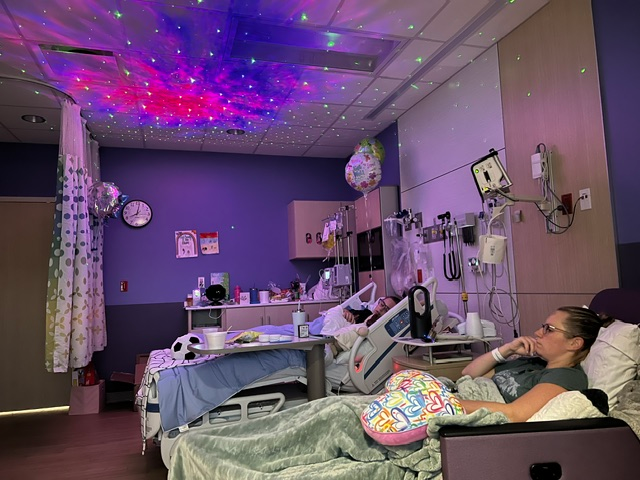
Whatever It Takes
June 3–9, 2025

Tuesday was chemo day.
Kinley was scheduled to receive her first round of chemotherapy, but nothing about the process was quick or casual.
Late the night before, someone came into the room to check her heart and make sure it was strong enough for treatment. The next morning, we got the all-clear.
Then came the fluids.
Bag after bag was connected to her IV. She needed to be hydrated and given nutrition because she still was not eating on her own. She could drink some water, but not enough to keep up with what her body needed.
A phrase kept coming to mind:
Safe and precise.
Every decision was planned, tracked, checked, and studied. Every human body is different, and the doctors wanted to get the treatment right from the beginning.
They were not taking chances.
We waited all day.
It was around ten o’clock that night before everyone felt comfortable enough to begin.
Crossing the Line
I knew that once chemotherapy started, we were taking another step in a direction that would be hard to come back from.
Chemo is tough.
But cancer is worse.
We were ready to face whatever came if it meant fighting the evil inside our little girl.
Still, it was impossible not to think about what the treatment itself might take from her.
Her hair.
Her senses.
Her ovaries.
Her strength.
Pieces of her childhood.
Life would never be the same.
But life was already not the same, and Kinley never got a vote in any of it.
It was bullshit.
Megan and I were technically being asked to make a decision, but to us, there was no decision.
Whatever it took.
Making the Best Decision We Could
Years earlier, I had read a book about the four wills of God. It used the acronym B.A.G.S.
Believe.
Abstain.
Give thanks.
Submit.
The idea was simple. We can spend so much time searching for some hidden version of God’s will that we miss the parts He has already made clear.
Believe in Christ.
Stay away from sin.
Give thanks in every circumstance.
Submit to God and do what is right.
When those things are in place, sometimes we simply have to make the best decision we can and trust God with it.
That did not make starting chemotherapy easy.
I was not thankful that Kinley had cancer. I will never be thankful for that.
But I could be thankful that we had answers.
Thankful for doctors who were careful and precise.
Thankful that treatment was available.
Thankful that we were surrounded by people who had spent their lives studying how to fight this disease.
Submission, in that moment, did not feel peaceful or spiritual.
It looked like signing the papers.
It looked like letting the nurses connect the medicine.
It looked like trusting God while also trusting the people He had placed in the room.
We did not receive a glowing sign telling us exactly what to do.
We had facts.
We had wise counsel.
We had an open door to treatment.
So we walked through it.
Whatever it took.
Grace for People Who Are Trying
Once someone is diagnosed with cancer, advice begins arriving from every direction.
“You should take her to Mexico.”
“You need to try holistic treatments.”
“Have you cut out sugar?”
“I saw a video about this treatment.”
Usually, it is not cruelty.
It is panic wearing a helpful hat.
People care. They feel helpless. They want to fix something they cannot fix, so they reach for the first hopeful thing they have heard and throw it into the room.
Part of me wanted to ask:
If your little girl had cancer spread throughout her abdomen, would you really pull her out of the hospital system you trusted most and take her somewhere else for a treatment that was still being developed?
Would you gamble her life on that?
Really?
And trust me, I am usually the holistic guy.
I believe many health problems can be improved by changing how we live.
Stop drinking so much alcohol.
Exercise.
Eat better food.
Get outside.
Sleep.
Fast.
Build community.
Take care of your body.
I believe all of that matters.
But we were way past sunshine and smoothies.
This was cancer.
This was throughout her abdomen.
This required war.
The more I thought about it, the more I was reminded of Job’s friends.
In Job 4, Eliphaz begins speaking to Job. He believes he is offering wisdom. He believes he understands why Job is suffering and what Job needs to hear.
But he does not.
He turns Job’s pain into a problem to solve. He offers an explanation when what Job really needs is someone willing to sit beside him in the ashes.
Job’s friends were actually at their best before they started talking.
They sat with him for seven days and seven nights without saying a word because they could see how great his suffering was.
Then they opened their mouths.
That part feels familiar.
When people see someone they care about hurting, silence can feel useless. We want to say something. We want to offer a treatment, a book, a theory, a diet, a podcast, or a story about someone’s cousin who beat impossible odds.
Sometimes the advice is helpful.
Sometimes it is not.
Sometimes it is Eliphaz with a Facebook account.
But most people are trying.
They see a little girl with cancer. They see parents who are terrified. They want to pull something hopeful out of their pocket and hand it to us.
Ecclesiastes says there is a time to speak and a time to remain silent. Most of us are still learning which one is which.
We did not have to follow every suggestion.
We could hear the love, ignore the advice, and keep moving.
We could say, “Thank you for caring,” and still say no.
We could reject the idea without rejecting the person.
Later, God rebuked Job’s friends because they had spoken wrongly about Him. Their confidence had exceeded their understanding.
That is a lesson for all of us.
Pain does not always need an explanation.
Sometimes it needs presence.
Sometimes the most faithful thing a person can say is, “I do not know what to say, but I am here.”
No one truly knows how they would react until they are standing beside their own child’s hospital bed.
So we tried to give people grace.
Not because their words were always right, but because love does not always know how to speak clearly when it is scared.
The Green Bags
By Friday, the chemotherapy had made Kinley very sick.
Cohen and I slept at the Hog House while Megan stayed at the hospital and went through the night with her.
The little green vomit bags had officially become part of our system.
Where Kinley went, the bag went.
She had been invited to a special screening of Lilo & Stitch on the fifth floor. Under normal circumstances, getting to a movie would have been simple.
Nothing was simple anymore.
Getting out of bed was a chore.
Getting into the wheelchair was a chore.
Going to the bathroom was a slow chore.
Even moving a few feet required planning, patience, and energy she did not have.

The physical therapist would come in and try to get her moving. Kinley eventually started pretending to be asleep so she could avoid it.
Megan and I knew exactly what she was doing.
We played along.
We were tired too.
At that point, parenting had become a constant exercise in choosing battles, and physical therapy was not at the top of the list that day.
We did eventually get her into the wheelchair and up to the movie.
She lasted longer than I expected.
For a little while, we were not talking about medicine, nausea, blood counts, or cancer.
We were just watching a movie.
It was a small break from reality, and small breaks had become precious.
Grocery Bags of Cucumbers
MeeMaw and Nan came to visit on Saturday.
The hospital was unusually quiet, which was nice.
MeeMaw arrived carrying a grocery bag filled with enormous cucumbers.
I still do not know what we were supposed to do with a hospital room full of cucumbers, but it provided some much-needed comic relief.
At one point, Nan stood up and stretched.
“Kinley, don’t ever get old,” she said.
Nobody seemed to catch the irony except Kinley and me.
Kinley gave her a look that said, Really?
I thought it was pretty funny.
Sometimes laughter arrives at inappropriate moments.
Sometimes that is exactly when you need it.
“Did They Catch It Early?”
Sunday night, Megan went home with Cohen so she could get him ready for camp and stop by The Refined Pantry to help the team prepare for the week.
That left Kinley and me at the hospital.
We had a pretty good night.
She slept from Sunday afternoon until six o’clock Monday morning, which felt like a miracle all by itself.
That morning, we sat together watching television while I drank coffee.
Then she asked me a question.
“Dad, did they catch it early?”
I did not know how to answer.
Honestly, I did not know whether we had caught it early or late.
Later than sooner was probably closer to the truth.
But I looked at her, nodded, and said, “Oh yeah.”
I watched relief settle across her face.
Maybe I should have answered differently.
Maybe I should have been completely honest.
But in that moment, she was not asking me for a medical timeline.
She was asking whether she was going to be okay.
And I needed her to believe that we were still fighting from a place of hope.
The Happy Dance
Later that morning, Kinley did physical therapy.
This time, she walked down the hallway.
One of her main doctors happened to be coming the other way. When he saw her standing and walking, he broke into a happy dance right there in the hall.
For him, it may have been a small sign of progress.
For us, it was enormous.
A few days earlier, she could barely get out of bed.
Now she was walking.
Slowly.
Painfully.
But walking.
That first week taught us what whatever it takes actually meant.
It meant signing papers you never wanted to see.
It meant watching medicine enter your child’s body while knowing it would hurt her before it could help her.
It meant green vomit bags, wheelchairs, missed meals, fake sleeping, and grocery bags full of cucumbers.
It meant listening for love behind clumsy words.
It meant remembering that people in pain usually need presence before they need explanations.
It meant making the best decision we could with the information God had placed in front of us.
It meant answering questions we were not prepared to answer.
It meant celebrating a walk down the hallway.
It meant choosing hope when the truth was too heavy to hand to a twelve-year-old over morning coffee.
We did not know what the next week would bring.
We only knew we had begun.
And once we began, there was no turning back.
Whatever it took.
After Kinley finally fell asleep for the night Megan and I sat down to enjoy a bucket of fried chicken. We survive another day, praise God.
Comments
One response
I pray for Kinley every day. Much love and prayers for your sweet girl.