
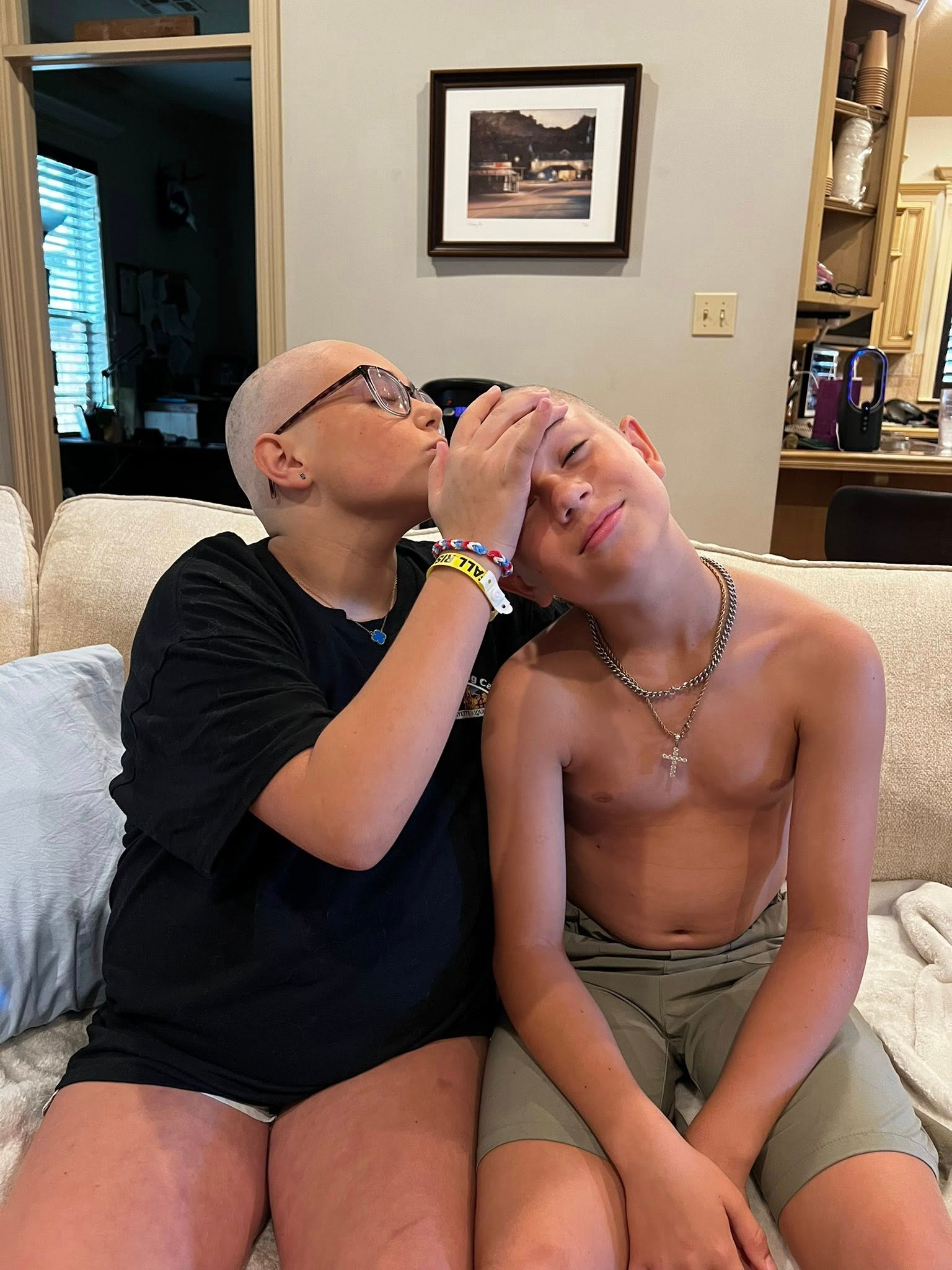
A few days after finally coming home, Megan woke around four in the morning to Kinley calling for help.
A very generous friend had let us borrow a bed that could incline, almost like a hospital bed, because Kinley could not lie flat on her back. Even with that setup, she usually chose the couch, propped up with pillows. The black bag is her food bag.

There was something about the couch that worked better for her during this time.
It also made it easier to call for us.
Megan heard her first.
I did not wake quite as easily, but once the vomiting started, sleep was pretty much over for everybody.
By then, nausea and vomiting had become one of the most consistent parts of treatment. It was awful, but it was no longer surprising.
That morning was going to be hard for another reason too.
Kinley’s hair had started coming out.
Over the previous week, we had put it into a ponytail and mostly left it alone. We knew that brushing it, washing it, or really doing much of anything with it would probably make a mess of what was already falling out.
We had delayed the moment as long as we could.
Now it was time.
Six Hours
Life at home revolved around the TPN backpack.
Kinley was connected for 18 hours a day, which meant the six hours she could be disconnected had become valuable.
We learned to be strategic with those hours.
If she felt well enough to get out, run an errand, ride in the car, or do anything that was easier without the backpack attached, we tried to fit it into that window.
That day, once she was disconnected, she felt good enough to get out for a while.
So we went.
We stopped by her cousins’ lemonade stand in their neighborhood.
While we were there, we ran into some of Kinley’s teachers from school.
That was special.
Her teachers had been incredibly supportive through everything, and seeing them somewhere outside a hospital or a medical conversation felt normal in a way we had not experienced much lately.
Then we made another stop.
Caroline’s Cookies.
Earlier that week, Caroline had asked Kinley to pick one of her favorite flavors, and they turned it into a special.
Kinley chose hot chocolate.
Of course she did.
Christmas has always been her favorite time of year.
The cookies had been selling out all week, and by the time we arrived, we managed to get some of the last few.
Caroline had written in one of her social media posts that Acadiana shows up for each other.
Read more: A Few Days LaterWe felt it.
We had been feeling it everywhere.
People were finding ways, big and small, to remind Kinley that she was not fighting alone.
Sometimes it looked like prayer.
Sometimes it looked like yellow ribbon stickers on mailboxes.
And sometimes it looked like a hot chocolate cookie in June.
“Can We Just Ride a Little Longer?”
We grabbed a quick lunch, but Kinley started fading fast.
That was another thing we were learning.
She might feel okay for a while, but her energy could disappear quickly.
I drove her home.
She was dozing on and off while we listened to music.
We started talking about hunting season.
Kinley loves hunting, and she told me how much she was looking forward to getting back into the woods.
We joked that hopefully, by then, she would not have to drag pumps, backpacks, and hospital equipment into the deer stand with her.
For a little while, we just drove.
Good music.
A tired kid beside me.
No hospital room.
No nurse walking through the door.
No one asking for her number.
Then Kinley looked at me and asked:
“Can we just ride for a little bit longer?”
So we did.
There are moments you know are important while they are happening.
That was one of them.
I did not care where we went.
I did not care how long it took.
My daughter wanted to ride around with her dad and listen to music.
After everything we had been through, there was nowhere else I needed to be.
It was just a car ride.
And I will remember it forever.
The First Cut
Later that afternoon, after Kinley got a good nap, my sister Jennifer came over with my brother-in-law Chad.
Jennifer cuts hair for a living.

She was there to help us with the big cut.
We let Kinley go first because she was still tired.
I took the first cut.
That was hard.
Really hard.

There are certain parts of cancer treatment that you know are probably coming.
Hair loss is one of them.
You know it intellectually.
You prepare for it.
You tell yourself it is just hair.
Then you are standing there with scissors in your hand, cutting off your daughter’s ponytail.
It suddenly does not feel like just hair.
It feels like another piece of normal being taken from her.
I was heartbroken.
Kinley was not interested in letting the room stay there.
She insisted this was not going to be a sad moment.
She joked.
She laughed.
She kept things light.
Once again, the person actually going through the hardest thing in the room was the one helping everyone else through it.
Then it was my turn.
Kinley got the clippers and shaved most of my hair.

That helped.
If her hair was going, mine was going too.
Then Cohen stepped up.
He decided he wanted his head shaved as well.

He did not hesitate.
At ten years old, hair matters.
A lot.
He was at that age where how it looked was becoming important.
But when it came to supporting his sister, none of that seemed to matter.
He sat down and shaved it off.
That moment said more about Cohen than anything I could write about him.
He did not make a speech.
He did not ask for attention.
He just did it.
Carrying What We Could
There is a verse in Galatians that says:
“Carry one another’s burdens, and in this way you will fulfill the law of Christ.”
Cancer taught me that carrying someone’s burden does not always mean removing it.
I could not take Kinley’s cancer and put it into my body.
I could not absorb the chemotherapy for her.
I could not make the nausea mine.
I could not stop her hair from falling out.
That helplessness was one of the hardest parts of being her dad.
But I could carry something.
When she wanted to ride a little longer, I could keep driving.
When her hair had to come off, mine could come off too.
Cohen could sit in that chair and shave his.
Her teachers could show up.
Our family could surround her.
Caroline could make a hot chocolate cookie and let an entire community rally around her.
None of those things cured cancer.
But they all said the same thing:
You are not carrying this alone.
Jesus showed us that kind of love over and over.
He entered people’s pain.
He touched the sick.
He wept with grieving friends.
He stayed close to people when life was at its worst.
Sometimes carrying someone’s burden simply means refusing to leave them alone underneath it.
The Toughest People in the Room
As I stood there watching Kinley joke while we shaved her head, I realized something.
I think I was the only one crying.
That sounds about right.
The women in my life are tough.
Megan had already fought cancer herself.
Now she was standing beside our daughter while Kinley faced it.
And Kinley, after everything she had already endured, was still making jokes and trying to keep the rest of us from getting too sad.
I wanted to be the strong one.
I wanted to absorb the fear.
I wanted to protect everybody.
But cancer has a way of exposing how little control you actually have.
I could not stop Kinley’s hair from falling out.
I could not make her appetite come back.
I could not guarantee she would be in a deer stand that fall without a pump strapped to her.
But I could sit beside her.
I could keep driving when she asked for a few more minutes.
I could shave my head.
Cohen could shave his.
We could laugh when she laughed.
We could cry when we needed to cry.
We could keep showing up.
That day was not good because cancer had somehow become easier.
It had not.
Kinley woke up vomiting.
Her hair was falling out.
Her body was exhausted.
She was still dependent on TPN.
But there was also a lemonade stand.
Teachers who happened to be there.
A cookie made just for her.
A community showing up.
A car ride with good music.
A conversation about hunting season.
A brother shaving his head.
A daughter determined to make everyone laugh while losing her hair.
Maybe that is what hope looked like for us in those early days at home.
Not pretending everything was okay.
Not calling the hard things good.
Just refusing to let the hard things be the only things we noticed.
And as I looked at Megan and Kinley, at the strength in both of them, I thought the same thing I had been thinking from the beginning.
These women in my life are tough.
Really tough.
We’re going to beat this thing.
I'm glad to hear your thoughts!