
June 22–28, 2025
For weeks, we had prayed for the same thing.
We wanted to take Kinley home.
Home had begun to feel almost mythical. Our own beds. Our own couch. Our own rooms. A place where people were not constantly walking in and out.
Hospital life had its own rhythm.
Someone came in to check vital signs.
Someone else brought food.
Someone randomly appeared and started cleaning the room.
Another person asked when Kinley had last used the bathroom.
Then came the question we heard so many times:
“On a scale from one to ten, how do you feel?”
Eventually, it was shortened to:
“What’s your number?”
None of this is criticism. The care team was amazing. Every check, every question, every interruption had a purpose.
But after weeks in the hospital, there was no real privacy.
There was no normal sleep.
There was no moment when you completely stopped being a patient or a caregiver.
Even when the room was quiet, you knew someone would eventually walk back in.
We wanted to go home.
But as badly as I wanted to leave, I was also afraid to.
Kinley was still hurting.
She still was not eating.
She still depended on medications, nutrition through her port, and nurses who knew exactly what to do when something changed.
Home was more than an hour away.
What if we got there and her pain became unbearable?
What if she started vomiting and could not stop?
What if the pump malfunctioned?
What if something happened in the middle of the night and the people who knew how to help were suddenly an hour down the road?
There was a strange security in the hospital.
I hated being there, but every alarm brought a nurse. Every fever had a protocol. Every question could be carried into the hallway and handed to someone wearing scrubs.
At home, Megan and I would become the first line of response.
I wanted to leave.
I was scared to leave.
Both were true.
Refuge Before Release
Before all of this happened, I had been mentoring a younger guy from church. There are some special people coming up in the next generation, and he is one of them.
During our hospital stay, he reached out to check on me.
The person I was supposed to be helping was now helping me.
He encouraged me to read Psalm 5, especially verse 11:
“But let all who take refuge in You be glad; let them ever sing for joy. Spread your protection over them, that those who love Your name may rejoice in You.”
It hit me right between the eyes.
I had connected joy with getting out of the hospital.
I thought joy was waiting at home.
But the verse did not say to rejoice once the circumstances improved. It said those who take refuge in God could rejoice in Him.
Even there.
Even with plans falling through.
Even with pain lingering.
Even with Kinley unable to eat and no discharge date we could trust.
Joy was not tied to a location.
It was tied to our refuge.
And our refuge had a name.
Jesus.
He never promised that following Him would keep us out of hospital rooms. He never promised that faith would protect us from fear, cancer, or nights filled with alarms.
What He promised was Himself.
Jesus said:
“Come to me, all of you who are weary and burdened, and I will give you rest.”
We were weary.
We were carrying more than we knew how to hold.
And Jesus was not waiting for us to become stronger before we came to Him. He invited us to come exhausted, confused, afraid, and desperate to go home.
The rest He offered did not mean our circumstances would suddenly become peaceful.
It meant we did not have to carry them alone.
Home would be a gift.
But home could not be our refuge.
Jesus had to be.
A Little Baseball in the Middle of It
During those final weeks in the hospital, the College World Series became part of our routine.
From May into June, we watched games from Kinley’s room. Baseball gave us something normal to follow in a life that no longer felt normal.
On June 22, we watched LSU play for the championship together.
For a few hours, we were not only a family trapped in a hospital room waiting on blood counts, medicine, and discharge plans.
We were LSU fans watching the Tigers compete for a title.
We cheered.
We talked about the game.
We shifted our attention away from cancer for a little while.
It did not change anything medically, but it gave our minds somewhere else to go.
That mattered.
Some hospital memories are made of procedures, machines, and bad news.
Some are made of baseball.
Learning What Going Home Required
The doctors did not suddenly walk in and announce that everything was fine.
Everything was not fine.
Kinley still needed significant support. She still was not eating enough to provide her body with the nutrition it needed.
Going home would only be possible if there was a safe plan to care for her outside the hospital.
That plan included TPN, or Total Parenteral Nutrition.
In simple terms, Kinley would receive her nutrition through her port instead of through food. The TPN would run for 18 hours every day, delivering calories, fluids, and nutrients directly into her bloodstream.
The remaining six hours would become the window when she could be disconnected.
Before we could leave, Megan and I had to be trained.
There were lines to connect.
Connections to sanitize.
A pump to operate.
Supplies to organize.
Alarms to understand.
Instructions for what to do if something went wrong.
We had spent weeks depending on nurses, and now the hospital was preparing to hand part of their job to us.
It felt less like discharge instructions and more like an accelerated nursing program with a final exam we were terrified to fail.
We paid attention.
We practiced.
We asked questions.
Then we asked the same questions again.
Going home was no longer as simple as putting Kinley in the car and driving away.
It meant bringing a piece of the hospital with us.
The doctors needed to know her body was stable enough.
The home health supplies needed to be arranged.
The TPN needed to be ready.
Megan and I needed to prove we could safely connect and disconnect everything.
We needed to know which alarms were annoying and which alarms meant we needed help.
Little by little, the plan came together.
Not because Kinley was suddenly better.
Because she was stable enough, and we had been given enough support to continue caring for her at home.
That difference mattered.
After 43 Days
Then the day finally came.
We had first taken Kinley to the hospital in Lafayette on May 17. The following day, she was transported to Baton Rouge.
By the time she was discharged, she had spent 43 calendar days in the hospital.
Forty-three days of sleeping in unfamiliar places.
Forty-three days of people walking in to check vital signs, bring meals, clean the room, draw blood, and ask for her number.
Forty-three days of procedures, chemotherapy, vomiting, hallway walks, hard conversations, and watching baseball from a hospital bed.
For six weeks, that hospital had become our entire world.
Now the medical team believed we had enough of a plan to continue caring for her at home.
That did not mean she was well.
It meant she was stable enough to leave, with support.
There is a big difference.
We packed our belongings, medications, instructions, and more medical supplies than I knew a family could fit into a vehicle.
We were finally going home.

And I was still nervous.
Living Around the Backpack
The TPN pump and nutrition bag were carried in a backpack.
A line ran from the backpack directly to Kinley’s port. When she was connected, the backpack stayed with her.
For 18 hours every day, it became part of her life.
That meant the six hours she could be disconnected became valuable.
We started planning around them.
When should she shower?
Did she feel well enough to leave the house?
Was there somewhere she wanted to go?
Could we take a drive?
Did she have enough energy to do anything at all?
If something was easier without the backpack, we tried to place it inside that six-hour window.
Our days had become a series of calculations.
How was she feeling?
What medicine was due?
When did the TPN need to start?
When could she disconnect?
How much could she handle without paying for it later?
The pump also beeped.
A lot.
We had spent weeks dreaming about escaping the hospital alarms, only to pack one into a backpack and bring it home as a souvenir.
It usually seemed to have its most urgent opinions in the middle of the night.
Still, when that pump beeped at home, it sounded different.
It was annoying.
It was stressful.
But it was beeping under our roof.
Food Without an Appetite
The irony of Kinley not eating was not lost on us.
Our family has never struggled to enjoy food.
Food is literally our business at The Refined Pantry. We prepare meals, sell meals, talk about meals, and spend a large portion of our lives deciding what other people should eat.
Now we could not convince our daughter to eat more than a few bites.
We tried to joke about it.
Maybe a good hamburger would restore her soul.
Maybe the right fries would unlock something.
Maybe one craving would lead to another.
But most of the time, she simply was not interested.
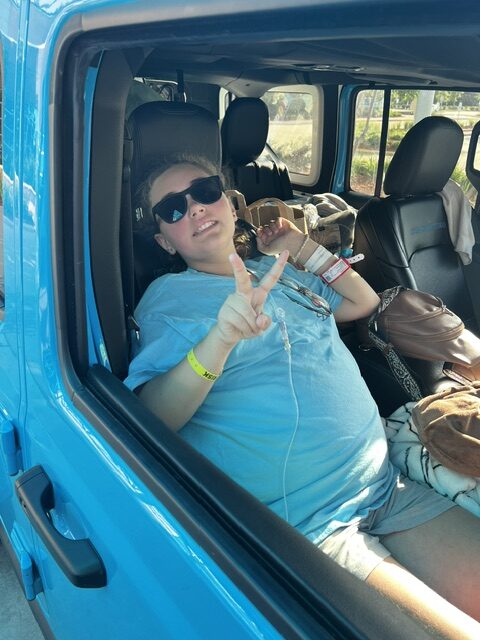
On the drive home, Kinley rode with Megan. She suddenly said she wanted Checkers fries.
That was enough for a detour.
At that point, any request for food felt like a small victory.
She ate a handful.
Later that night, she threw them up.
It was not the triumphant return to eating we had imagined.
But for a moment, she wanted something.
We had learned to celebrate desire before results.
Yellow at the Mailboxes
When we entered our neighborhood, yellow ribbon stickers were displayed on mailboxes throughout the streets.

On our front door, there was an actual yellow ribbon.
Yellow represents childhood cancer awareness, but that day it felt personal.
It felt like our neighbors were saying:
We see you.
We have been praying.
We are glad you are home.
There were many people who wanted to come by and see Kinley.
We were grateful.
We also had to put up some blockers.
The car ride had been difficult enough. Kinley was exhausted and needed quiet. Coming home did not mean she was ready for a parade of visitors.
She was home.
She was also still very sick.
We had to protect both truths.
The Refuge Came Home With Us
For weeks, I had imagined our house as the finish line.
I thought crossing the threshold might make everything settle.
And some things did.
There was comfort in our own beds.
Our own couch.
Our own rooms.
The familiar sounds of the house.
But home did not remove the cancer.
It did not restore Kinley’s appetite.
It did not eliminate the pain or the fear.
It did not free us from medicine, machines, or responsibility.
The hospital followed us home in a backpack.
That was when Psalm 5 began to make more sense.
Our joy could not depend on returning to normal because normal was gone.
Our joy could not depend on Kinley feeling well because some days she would not.
Our joy could not depend on a silent pump because that thing clearly had no interest in cooperating.
Joy had to come from something that could not be taken away by a diagnosis, a discharge plan, or another difficult night.
It came from Jesus.
We saw His care in a younger man checking on the person who was supposed to be mentoring him.
We saw it in nurses patiently teaching us how to care for Kinley.
We saw it in College World Series baseball giving our minds somewhere else to rest.
We saw it in yellow ribbon stickers covering neighborhood mailboxes and the ribbon waiting on our front door.
We even saw it in the irritating beep of a TPN pump because that pump was helping sustain our daughter.
After 43 days, we finally brought Kinley home.
The backpack stayed close.
The pump beeped.
The fries came back up.
Kinley was not healed, and the road ahead was still frightening.
But Jesus had carried us through the hospital.
And He came home with us.
There was real joy in that.
