
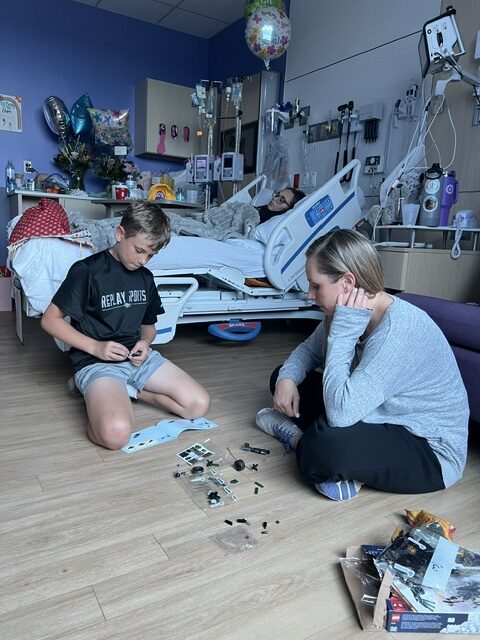
The Day the Waiting Had a Name
June 2, 2025
The night before, Megan took Cohen home.
The plan was for her to get a decent night’s sleep, spend some time at The Refined Pantry in the morning, and stop by the blood drive our family and friends had organized in Kinley’s name.

There was already a lot going on.
Our team at the Pantry was trying to keep things moving without us. Family and friends were stepping up everywhere. People were coming to donate blood for Kinley.
I stayed at the hospital with her and expected a quiet Monday.
Nope.
Around 10:30 that morning, the doctor came by.
She said they had received the pathology report and wanted to know if we were ready to talk about it.
I told her Megan was not there, but we could talk.
She asked if I wanted to get Megan on the phone.
That was the first moment I thought, This does not sound good.
Megan and I had already agreed that we would rather hear news sooner than later. If one of us was not there, the other should get the information as soon as possible.
But I looked at the time.
It was crunch time at the Pantry.
The blood drive was about to begin.
And I did not want to turn Megan into a puddle in front of everyone.
So I told the doctor to continue.
She started talking.
I stopped her.
“If this is something serious, we probably need to step into another room.”
At that point, Kinley was still scared, and Megan and I were trying to let information come through us and the Child Life Specialist before it reached her.
After making sure Kinley would be okay for a few minutes, we stepped into the hallway.
Then she said the words.
“Kinley has desmoplastic small round cell tumor.”
DSRCT.
Rare.
Aggressive.
She kept talking.
After the first couple of sentences, I was listening, but I was not hearing.
All I could think was, Man, I wish Megan was here.
The doctor continued trying to explain what they knew and what they were still working on.
Finally, I interrupted her.
“Wait. Is there hope?”
She said, “Of course there is hope.”
I told her, “Well, that is what we are going to go with for now.”
Looking back, I think that may have been the beginning of the Hopified thought process.
And then I walked away.
That was all I could hold.
Hope.
Not statistics.
Not research.
Not treatment plans.
Not rare.
Not aggressive.
Hope.
Around lunch, Megan texted and asked if there was any news.
I told her Kinley had just done some physical therapy and there was no news.
That was not true.
I hated lying to her.
But I could not bring myself to tell her through a text message, in the middle of the blood drive, with people all around her.
So I waited.
Later that afternoon, Megan texted again and asked how things were going.
I told her Kinley was doing okay.
Uneventful.
She believed me.
Meanwhile, I was a mess inside.
A shell of a man trying to act normal through text messages.
My daughter had just been diagnosed with a rare and aggressive cancer.
My wife had no idea.
And I was sitting in a hospital room pretending nothing had happened.
The doctors kept asking when Megan would be back.
I kept telling them, “As soon as possible.”
Finally, I could not do it anymore.
I texted her:
“Please come to the hospital. I can use some backup.”
She simply replied:
“On the way.”
About halfway there, she messaged again.
“What’s going on?”
I could not answer.
Around 5:30, Megan arrived with Cohen.
Not long after she walked into the room, the medical team came in.
I had warned Megan that the doctors wanted to talk to us, so when they arrived, we asked Cohen to stay with Kinley while we stepped across the hall.
We went into a conference room.
There was a picture on the wall of a big fat cartoon frog.
For some reason, I noticed it immediately.
It took me back to the room where Megan and I first heard her cancer diagnosis.
That room had peaceful artwork.
This one was different, like the frog was getting shocking information.

Megan and I sat at a four-seat round table with the lead doctor and lead nurse.
There were several other doctors in the room, along with Kinley’s Child Life Specialist.
Then the doctor confirmed the diagnosis.
Desmoplastic small round cell tumor.
DSRCT.
Extremely rare.
Aggressive.
Not much research to go on compared to more common cancers.
Over time, we would learn more about what those words actually meant.
DSRCT is a rare type of soft-tissue cancer called a sarcoma. It most often develops in the abdomen and pelvis and is seen mainly in children and young adults, especially males.
Under a microscope, it gets its name from the appearance of small, round cancer cells growing within dense, scar-like tissue. At the genetic level, DSRCT is also associated with a specific fusion between two genes, EWSR1 and WT1. That unusual genetic change is one of the main ways doctors can identify and confirm the disease.
Part of what makes DSRCT difficult to fight is the way it behaves.
It often does not present as one clean, isolated tumor that can simply be removed. It can involve multiple areas throughout the abdomen and pelvis, which can make complete surgical removal difficult.
And because the disease is so rare, there is less research and experience to guide treatment than there is with more common cancers. Treatment often requires attacking it from several directions, using aggressive chemotherapy, surgery when possible, radiation, and sometimes clinical trials.
In simple terms, this was not going to be a short or simple fight.
But now we finally knew what we were fighting.
Then came the plan.
Twenty-seven weeks of chemotherapy.
A week-on, week-off schedule.
Every treatment inpatient.
Even if we were able to go home in the months ahead, Kinley would need to be admitted for every round and stay as long as necessary depending on how her body responded.
I remember asking the doctor one question.
“Are you comfortable doing this treatment process here?”
He told us we had a choice.
We could stay in Baton Rouge or go to the main St. Jude campus in Memphis.
The treatment would be the same.
Then he said something that gave us confidence in him.
He told us he was not too proud to say if another hospital would be a better fit.
But he believed they could take good care of Kinley in Baton Rouge to start.
That mattered.
Megan and I agreed.
Starting close to home felt like the right choice.
Family and friends could visit.
We could get home more easily.
Work would be more manageable.
There was at least some version of our life still within reach.
The doctor kept going.
They believed chemotherapy was the best route forward, and Kinley’s response would be tested throughout the process.
If it worked, we would continue.
If it did not, we would not waste time continuing something ineffective.
Then he mentioned option B.
A clinical trial in Memphis.
And if that did not work, there was an option C.
I remember something about that conversation giving me a strange sense of comfort.
Not because any of the options sounded easy.
They did not.
But there was a plan.
For weeks, we had waited.
Waited for pathology.
Waited for answers.
Waited for doctors.
Waited for someone to tell us what this thing was.
Now the waiting finally had a name.
DSRCT.
I hated the name.
I still do.
But now there was something to fight.
There was a plan A.
There was a plan B.
There was even a plan C.
We were not walking out of that room with good news.
But we were walking out with direction.
And sometimes, when you have been lost in the fog long enough, direction feels a lot like mercy.
Looking back, I think differently now about the word hope.
Biblical hope is not pretending everything will turn out exactly the way we want.
It is not positive thinking.
It is not ignoring the diagnosis.
It is not looking at something painful and calling it good.
Romans 5 says that suffering produces perseverance, perseverance produces character, and character produces hope.
That sequence makes more sense to me now.
Hope is not always something you feel before the hard part starts.
Sometimes hope is what God grows in you while you are walking through it.
We did not leave that conference room feeling good.
We left with a diagnosis we hated.
We left with a long treatment plan.
We left knowing hard days were ahead.
But we also left with something else.
Hope.
Not because the road looked easy.
Not because we knew how the story would end.
Not because our fear disappeared.
But because we believed God would be with us on the road.
That morning, I had asked one question.
“Is there hope?”
The answer was yes.
So that is what we decided to go with.
Hope.