
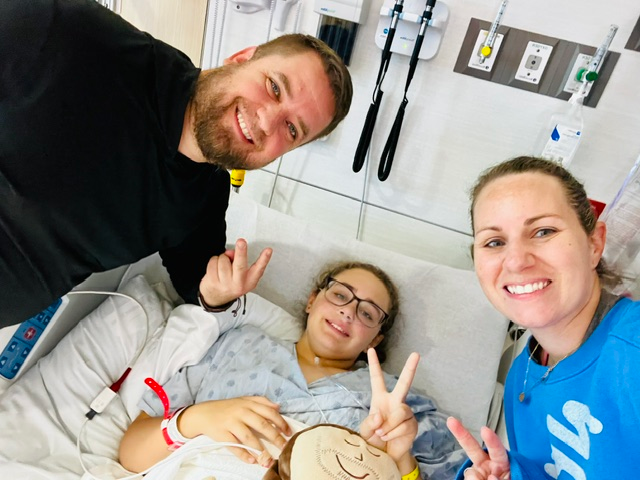
Good Hours and Bad Hours
Memorial Day, May 26–27, 2025
Today was rough.
Megan had gone home the afternoon before with Cohen. Kinley and I had a good evening together, just hanging out and watching Duck Dynasty. Overnight, she was awake quite a bit, but she was still in good spirits.
Then morning came, and it was like she hit a wall.
Her belly had filled with so much fluid that she looked like she had become pregnant over the past few days. The pressure was painful and uncomfortable, but worse than that, she was struggling to breathe. She could not find a position that gave her any relief.
Tylenol was not helping.
Oxycodone was not helping.
Morphine was not helping.
Around 7:30 that morning, Kinley was crying and clearly angry. Nurses and doctors kept coming in and out of the room, working through possible ways to make her comfortable. Everyone was trying to help, but to her, it did not feel like help.
When we finally had a brief moment alone, she cried out to me,
“Nobody wants to help me. They only want to pump me full of medicine!”
I understood why she felt that way.
She did not want another pill or another medication flowing through her IV. She wanted the pressure gone. She wanted to breathe. She wanted somebody to fix what was actually hurting her.
As the pain continued, fear began to take over. She started hyperventilating. With that much pressure already pushing against her lungs, it was no surprise that she could not catch her breath.
The doctors had ordered Lasix, a medication that would make her urinate more and hopefully pull some of the excess fluid from her body. We had been trying to wait until Megan returned, but Kinley needed relief.
Waiting was no longer an option.
We started it.
I wish I could say I handled that morning with unwavering faith.
I did not.
I was struggling with God. I hated what was happening. I hated watching my daughter suffer. I hated feeling helpless while people offered medications that did not seem to touch the real problem.
Did I have faith?
At that moment, I honestly did not know. What are we doing here God?
Anyone can say they have faith when life is calm. It is easy to talk about trusting God when your child is not crying because she cannot breathe. But sitting beside Kinley that morning, I felt like I had reached my breaking point.
I have always considered myself a patient person. I can take a lot.
But this was a nightmare.
Kinley has always been modest and reserved. She was normally not happy about me helping her use the bathroom. But that morning, modesty no longer mattered. She just wanted relief.
That told me how bad it had become.
Up to that point, I had been trying to shield Megan from how quickly things were getting worse. She was back in Lafayette at The Refined Pantry, trying to help the team get off to a good start.
At 7:45, I finally called her.
I told her she might want to plan on coming back sooner rather than later.
She could hear it in my voice. She knew something was wrong.
A trip that normally took around an hour and fifteen minutes somehow took her about an hour, and she still had to stop at home to pick up Cohen. I am not asking too many questions about the speed involved. I was just grateful when she walked through the door.
By the time Megan arrived, the Lasix had been started.
And she was a welcome sight.
There are moments when the presence of the right person changes the whole temperature of a room. Megan did not arrive with a cure. She did not have answers the doctors did not have. But she was Mom.
And Kinley needed her mom.
Eventually, the team was able to get Kinley calmer and more comfortable. Megan and I met with several doctors, and everyone agreed that it was time to move forward with a procedure. Using ultrasound guidance, they would drain the fluid and blood that had accumulated in her abdomen.
Because it was Memorial Day and the hospital had seen an increase in emergency procedures, they could not schedule hers until Tuesday morning.
So once again, we waited.
But this time, at least we knew something was coming.
The next morning, they took Kinley back around 9:45.
She was more excited than nervous.

That may sound strange for a child going under anesthesia, but she was relieved that someone was finally doing something to address the pressure instead of simply asking her to endure it.
They adjusted the medication they used during anesthesia because of the concern about her blood loss.
Then came recovery.
When Kinley woke up, she gave the entire recovery room a show.
In her mind, she was apparently at her zoo in Africa, and we were letting all of her animals out of their cages.
She told me that she did not have a father.
Then she informed me that I was a goldfish.
Megan was an alligator.
The main nurse was a crab.
She also became deeply concerned about finding the fish tank with the octopus whose “testicles” were stuck to the glass.
Tentacles.
She meant tentacles.
But nobody in that recovery room was going to correct her because we were all laughing too hard.
After the fear of the day before, her drug-induced African zoo felt like a gift.
The laughter did not erase what had happened.
It did not make the cancer disappear.
It did not change the fluid, the bleeding, or the long road ahead.
But for a few minutes, laughter filled a space that had been occupied by fear.
And we needed it.
Tuesday was a good day.
Monday was not.
That is how life had begun to work for us.
Good days and bad days no longer seemed accurate. Things changed too quickly for that. We had good hours and bad hours.
One hour, Kinley could be crying in pain, unable to catch her breath.
The next, she could be calling her father a goldfish and asking about an octopus’s testicles.
One hour, my faith felt like it was collapsing.
The next, I could see God’s grace in the arrival of Megan, in the hands of the doctors, in the relief after the procedure, and in the sound of Kinley making a recovery room laugh.
Maybe faith is not always feeling certain.
Maybe faith is not pretending that suffering does not shake you.
Maybe sometimes faith is admitting that you are angry, exhausted, and hanging on by a thread, but still turning toward God with whatever little bit you have left.
We are continuing to trust Him through this storm.
We are continuing to praise Him, even when praise feels difficult.
We are praying that somehow, through all of this, He will use our family to show His glory.
But on that day, I could not pray very far into the future.
The next week felt too heavy.
The next test felt too uncertain.
Even the next day seemed like too much to carry.
So my prayer became smaller.
More honest.
More desperate.
Dear God, please let the next hour be a good one.
I kept thinking about Elijah in 1 Kings 19.
I had taught this story before in the men’s group I lead. I had walked through the passage, discussed what Elijah experienced, and talked about how even a strong man of God could reach the end of himself.
Elijah had just witnessed God move in an undeniable way. Fire had fallen from heaven. Yet only a short time later, he was afraid, exhausted, and alone in the wilderness. He sat beneath a broom tree and told God he had experienced enough.
I had taught that story.
But now I felt like I understood it.
There is a big difference between studying someone’s breaking point and reaching your own.
Sitting beside Kinley while she cried in pain and struggled to breathe, I felt like Elijah beneath that tree. I had nothing impressive left to offer God. No confident speech. No strong declaration. No lesson neatly divided into three points.
I was exhausted.
I was angry.
I was scared.
And I had experienced enough.
What stands out to me now is how God responded to Elijah. He did not shame him. He did not accuse him of weak faith. He did not immediately give him a sermon or demand that he pull himself together.
God let him rest.
Then an angel brought him food and water.
Elijah slept again, and God cared for him again.
Only after that did God tell him there was still a journey ahead.
That changes the way I understand exhaustion. Sometimes the most spiritual thing a person can do is admit they have nothing left. Sometimes God’s provision does not arrive as an explanation. Sometimes it looks like sleep, food, medicine, a procedure that brings relief, or your wife finally walking through the hospital-room door.
That day, Megan’s arrival felt like provision.
The doctors deciding to drain the fluid felt like provision.
The relief Kinley experienced afterward felt like provision.
Even the laughter in the recovery room felt like provision.
None of it answered every question. None of it showed us the entire road ahead. But God did not ask us to walk the entire road that day.
He gave us what we needed for the next part of the journey.
I used to teach that Elijah was not faithless beneath that tree. He was depleted.
Now I know the difference firsthand.
I was not walking away from God. I was collapsing in front of Him.
And perhaps that is still an act of faith.
To fall apart in His presence instead of somewhere else.
To tell Him that I have experienced enough.
To receive whatever care He provides.
And then, when He gives me strength, to get up and walk into the next hour.