
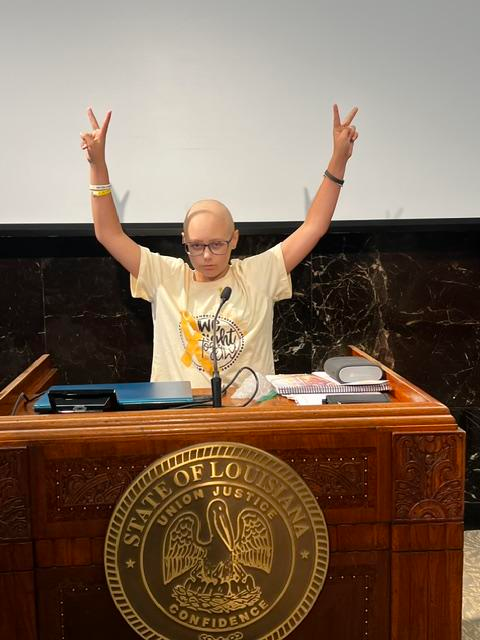
September is Childhood Cancer Awareness Month.
Before cancer entered our family, I knew that in the same general way most people probably do.
I knew children got cancer.
I knew St. Jude existed.
I knew there were ribbons and fundraisers and families going through unimaginably hard things.
But awareness changes when the child has your last name.
It changes when you know what chemotherapy smells like.
When you know what a blood count means.
When you know which hospital food your kid will tolerate.
When you know how quickly a normal day can turn into an emergency.
When you know the names of the nurses working overnight because they have become part of your life.
Childhood cancer awareness stopped being something on a calendar.
It became our family.
September 9, 2025

A friend of Megan’s family, Dr. Vidrine, reached out to the Governor’s office with a request.
She wanted September 9th to be dedicated as Childhood Cancer Awareness Day in Louisiana.
Governor Landry’s office agreed, and plans started coming together for a ceremony at the Capitol.
There was just one thing they still needed.
A patient representative.
Somehow, that became Kinley.
I wish I could say I was excited about that without any mixed emotions.
I was proud of her.
Very proud.
But there is also something strange about your daughter being selected to represent children with cancer.
It is an honor you would gladly give back.
We never wanted to qualify for this club.
But since we were already in it, we wanted to represent these kids well.
Take Care of the People Taking Care of Your Kid
I am not saying we received special treatment at the hospital.
I genuinely believe the doctors and nurses take incredible care of all of these children.
But I would be remiss if I did not find it funny that most of the time we showed up at Children’s Hospital in Baton Rouge, Megan also showed up carrying big bags of food for the nurses.
Go figure.
We tried from the beginning to build genuine relationships with the people taking care of our girl.
They deserved it.
These nurses walk from one room where a family may be receiving terrible news into another room where somebody is celebrating a milestone.
One child is vomiting.
Another is scared.
Another family is exhausted.
Another might finally be going home.
They have to walk into each room, read it, and somehow meet those people where they are.
They have to care genuinely.
They do not really get the luxury of bringing their bad day into the room.
And yes, I learned something else along the way.
Some parents can be jerks.
We saw people treat nurses like servants or maids. I understand the fear. I understand the exhaustion. I understand being angry at the world.
But I have told our kids throughout this whole experience:
It is okay to be sad.
It is okay to be scared.
It is okay to be angry.
It is never okay to be a jerk.
Your circumstances can explain your emotions.
They do not excuse how you treat people.
So when a nurse walked into Kinley’s room smiling and said, “Yay! I get to take care of you tonight,” Megan and I took a lot of pride in that.
Not because we wanted special treatment.
Because we wanted the people caring for Kinley to know that we saw them too.
Aaron
That lesson extended beyond the nurses and doctors.
On the day of the Capitol ceremony, some of our extended family came with us, along with one of Kinley’s main doctors and several hospital administrators.
I had the opportunity to spend some time with the president of the hospital.
I told him how incredible the medical team had been.
But I also made sure to tell him about the security team.
Especially Aaron.
Aaron seemed to always be around during those first weeks when I was at my worst.
There were times he would see me walking through the lobby upset, leave his desk, walk around, and hug me.
He would tell me:
“Don’t lose faith, my brother. God’s got this.”
He probably had no idea how much I needed that.
I have joked that Children’s Hospital had the nicest security guards you could ever meet, who would also absolutely shred anyone who tried to mess with one of those kids.
It was the perfect combination.
Kindness and protection.
Aaron was not prescribing medicine.
He was not reading scans.
He was not making treatment decisions.
He was just a man standing in the lobby who noticed another man hurting.
Sometimes that is ministry.
A Day for the Kids
When we arrived at the Capitol, we were brought into a committee room.
The Governor was unable to attend the ceremony, so a representative from his office spoke on his behalf.
She talked about the children diagnosed with cancer.
Their families.
Their doctors.
Their nurses.
Their care teams.
Then she called us to the front.
September 9 had been dedicated in Louisiana as a day to recognize children fighting cancer and the people walking beside them.
The ceremony itself was pretty short.

But standing there felt bigger than the few minutes it took.
Because Kinley was not only standing there for herself.
She was representing other kids.
Kids sitting in hospital rooms.
Kids missing school.
Kids losing their hair.
Kids vomiting after treatment.
Kids learning words like chemotherapy, platelets, ports, radiation, and transfusions long before they should ever have to.
She was standing there for their brothers and sisters too.
For their moms and dads.
For the nurses who go home carrying pieces of these families with them.
For the doctors who sometimes have to walk into a room knowing they cannot give the answer everybody wants.
For the Aarons standing in hospital lobbies reminding people not to lose faith.
We were proud to be there.
Not because childhood cancer had given us some special status.
But because if Kinley had to carry this diagnosis, maybe we could use the attention that came with it to help people see the other kids carrying it too.
Pain Is a Microphone
There is a thought from Levi Lusko that I have carried with me:
Pain is a microphone.
Pain gets attention.
When somebody has actually walked through something difficult, people tend to listen differently.
That does not make the pain good.
It does not mean we should chase suffering.
And I certainly do not believe God gave Kinley cancer so that our family could have a platform.
I would trade every platform, every proclamation, every opportunity, and every person who knows our story if it meant Kinley never had to experience any of this.
But that is not the story we were given.
And once pain gives you a microphone, you have to decide what you are going to say into it.
Saul, Paul, and Suffering
That idea makes me think about Acts 9.
Saul had been persecuting Christians when Jesus met him on the road to Damascus and completely changed the direction of his life.
God then spoke to Ananias about Saul and said:
“I will show him how much he must suffer for my name.”
That is an interesting way to introduce one of the most influential men in the New Testament.
Not:
Look how successful he will be.
Not:
Look how comfortable his life will become.
But:
He is going to suffer.
And he did.
Paul would experience imprisonment, beatings, rejection, threats, hardship, and loss.
Yet his suffering did not silence him.
His voice carried farther.
He preached Christ.
He planted churches.
He wrote letters from prison that Christians are still reading thousands of years later.
His pain became part of the microphone.
But pain was never his message.
Jesus was.
That distinction matters to me.
What Will People Hear?
I do not know why Kinley has had to suffer the way she has.
I do not have a neat theological answer that makes cancer make sense.
And I have become increasingly suspicious of people who think every terrible thing needs a tidy explanation.
Some things hurt because they hurt.
But I do believe God can redeem what He does not delight in.
I believe He can take what is evil and produce something good through it.
And I believe suffering does not have to be wasted.
People are watching Kinley.
They are watching the way she laughs.
The way she jokes with nurses.
The way she loves people.
The way she keeps going when her body is tired.
They are watching our family too.
And that is humbling because we certainly do not get all of this right.
We get scared.
We get frustrated.
We get tired.
Sometimes we do not know what to say.
But if cancer has handed our family a microphone, then I pray people hear something more than cancer.
I pray they hear hope.
I pray they hear compassion.
I pray they see the importance of taking care of people who are hurting.
I pray they notice the nurses.
The doctors.
The siblings.
The security guards.
The families sitting quietly in rooms next door.
I pray they understand that childhood cancer is not a ribbon or a month on the calendar.
It is children.
Real children.
And families trying to figure out how to keep living while fighting for them.
But more than anything else, I pray people hear Jesus.
Not because faith has made this easy.
It has not.
Not because we understand everything God is doing.
We do not.
But because through hospital rooms, chemotherapy, fear, exhaustion, laughter, tears, and everything in between, Jesus has remained.
The Office We Didn’t Get to Use
After the ceremony, we were invited to the Governor’s office.
We hoped we might get a chance to meet him.

We waited for a while and were able to tour the office, but his schedule never opened up. His staff told us he had gotten caught up in meetings and there was no real estimate for when he might be available.
That was okay.
Meeting the Governor was never really the point.
The point was the kids.
The point was awareness.
The point was standing in that building and reminding people that childhood cancer is happening in families all across Louisiana.
And maybe the point was also recognizing that Kinley had been given a microphone.
Not one we asked for.
Not one we wanted.
But one people were listening to.
We plan to keep using it.
For the kids fighting.
For the families exhausted beside them.
For the people caring for them.
And for the God who has continued meeting us in places we never wanted to be.
Paul’s pain became a microphone.
So has Kinley’s.
And if people are willing to listen, then I know what I want them to hear.
Cancer may be the microphone.
But Jesus is the message.
I'm glad to hear your thoughts!