
June 16–20, 2025
On Monday, the doctors decided to take a little more time before starting Kinley’s next round of chemotherapy.
They wanted to get her fluids up and make sure her body was strong enough to handle what came next.
Dr. Bains, one of the resident doctors, stopped by to check on her. He was not assigned to our floor that week, but he was rotating through different areas of the hospital to gain more experience.
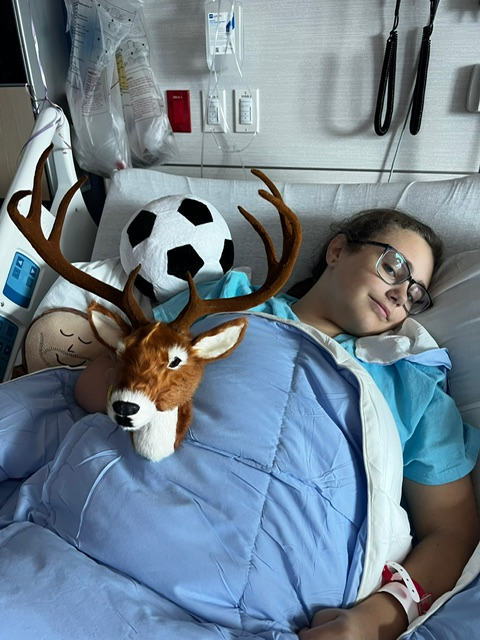
During one of his earlier visits, he had noticed the stuffed deer heads hanging in Kinley’s hospital room and learned that she liked to hunt.
That day, he walked in carrying two Nerf guns.
One for Kinley.
One for me.
It was such a small thing, but it was also one of the most thoughtful moments of our hospital stay.
I cannot fully explain it, but I felt God’s comfort in that room.
Kinley and I started shooting Nerf darts at the wall. For a little while, we forgot about chemotherapy, blood counts, nausea, and everything waiting outside that moment.

We laughed until we cried.
Sometimes God’s comfort does not arrive through a dramatic sign.
Sometimes it walks into a hospital room carrying two Nerf guns.
A Lighter Week
Chemo round number two began on Tuesday.
We had been told this would probably be the easier week when it came to side effects.
That sounded good.
We were ready for easier.
We were wrong.
By Friday, Kinley was on nearly every nausea medication the hospital could give her, and she was still sick.
But the nausea was no longer the scariest part.
Over the previous few days, we had noticed a small twitch in one of her fingers. At first, it did not seem like much. Then the twitching spread.
Her eyes began to move uncontrollably.
Her body started trembling.
She lost control of normal bodily functions.
She drifted in and out of consciousness.
At times, she was completely unresponsive.
This was not another ordinary bad day after chemotherapy.
This was terrifying.
The doctors believed the ifosfamide, one of the chemotherapy drugs she was receiving, was causing a serious neurological reaction. After several meetings, examinations, and attempts to understand what was happening, they decided to stop that part of her treatment.
The following day, they would continue with only one of the chemotherapy drugs and begin giving her vitamins and other support to help her body recover.
Kinley could sometimes squeeze the doctor’s hand.
Occasionally, she could tell them her name.
Then she would slip away again.
I would rub her head and speak to her.
Every so often, she would open those blue eyes.
I told her everything was going to be okay.
She gave me a small smile.
I had no idea whether everything was going to be okay.
I only knew that fathers are supposed to protect their daughters, and I had never felt more powerless.
I could not fight the cancer myself.
I could not remove the medicine from her body.
I could not force her to wake up.
I was no match for what was happening inside her.
All I could do was stay close, rub her head, and keep speaking hope into the room.
We Have Another Child
That night was Cohen’s final night of Vacation Bible School.
His group had a performance, and families were coming to watch.
I did not want to go.
I did not want to leave Kinley.
I did not want to be around people.
I called my sister to talk about the plan for the evening, but I could barely put a sentence together.
I was scared.
I told Megan I was not going anywhere.
She reminded me of something I could not afford to forget.
“We have another child.”
She did not really give me a choice.
Kinley needed the comfort of her mother in that moment. She was twelve years old, vulnerable, frightened, and drifting in and out of consciousness.
And Cohen still needed one of his parents to show up for him.
That is one of the hardest parts of walking through a crisis as a family.
The emergency does not cancel everyone else’s needs.
One child is lying in a hospital bed, and the other is still growing up.
Cohen still had a performance.
He still needed someone in the audience.
He still deserved to look out and see his dad.
Kinley was stable, so at the last minute, I decided to go.
Faking a Smile
Have you ever had to fake a smile?

I felt empty, defeated, and completely out of place.
But where better to go when you are running on fumes than an old country Baptist church?
My dad is a Deacon at Terry’s Creek Baptist Church. That church had wrapped its arms around our family with prayer, grace, and practical help.
They loved our children.
They loved serving people.
And they had chosen to love us during one of the hardest seasons of our lives.
Each year during Vacation Bible School, they raised money for missions or another area of need.
That year, they chose our family.
When they announced it, I was overwhelmed.
My dad asked whether I wanted to say anything.
I told him I could not.
He said, “No worries. I’ll do it for you.”
Sometimes someone else has to speak when you have no words left.
A Small Kitchen Tupperware
The moment that affected me most came when my dad handed me a small kitchen Tupperware.
It had been given by a widow whose husband had recently died from cancer.
During his illness, people had surrounded her with love and support. Now she wanted to pass that same kindness forward to our family.
She had one condition.
When we were able, we should do the same for someone else.
From what I understood, she did not live an extravagant life. This was not money she would never notice was gone.
She could have kept it.
She could have used it to make her own life a little easier after losing her husband.
Instead, she gave it away.
It reminded me of the widow Jesus saw at the temple.
Many wealthy people placed large gifts into the offering. Then a poor widow came forward and gave two small coins.
On paper, her gift looked insignificant.
Jesus said it was greater than all the others.
The rich had given from what they had left over.
She had given from what little she had.
The power of her gift was not in the amount.
It was in the sacrifice.
That small kitchen Tupperware felt heavier than a large check from someone who would never miss the money.
It carried her grief.
It carried the love people had once shown her.
It carried the choice to let her suffering open her hands instead of closing them.
She had been cared for during her darkest season, and now she was using what she had to care for us during ours.
That was not charity from a comfortable distance.
That was one wounded person reaching through the darkness to find another.
It was one of the most generous gifts I have ever received.
Celebrating Cohen Without Hurting Kinley
I recorded videos of the VBS performance and sent them to Megan so she and Kinley could watch Cohen.
Even that required some care.
Kinley was already upset because she was missing another week of camp. Earlier that summer, she had also missed what would have been her first overnight camp.
We wanted her to celebrate her brother.
We also did not want to wave everything she was missing in front of her.
There was no perfect way to handle it.
We were trying to celebrate one child while grieving for the other.
That had become part of our new reality.
When We Cried Out for Help
Around that same time, Megan went to social media and asked people to pray.
There had been several moments during this journey when we felt desperate enough to cry out publicly for help.
This was one of those moments.
I probably should have known something was happening when my phone began lighting up with messages.
People were praying.
People were encouraging us.
People were calling out Kinley’s name before God.
Back at the hospital, Megan played one of the videos for her.
Kinley opened her eyes.
Then she sat up.
She began talking with Megan and the nurse.
She was completely coherent.
After everything that had happened earlier that day, it felt like a miracle.
She had gone from being unresponsive and barely able to answer simple questions to sitting up and talking.
I do not know how to explain the timing.
I do not claim to understand every medical detail or exactly what changed in that moment.
I only know that we had cried out for prayer, people responded, and our little girl opened her eyes.
Seeing the Good Through the Bad
Megan and I often say that we are trying to see the good through the bad.
That does not mean pretending the bad is not there.
The bad was very real that day.
It was tremors.
It was fear.
It was our daughter losing consciousness.
It was watching doctors test whether she could squeeze a hand or say her own name.
It was leaving one child in a hospital room so I could show up for the other.
It was forcing a smile while feeling hollow inside.
Seeing the good through the bad does not mean calling cancer good.
It means recognizing that evil does not get to occupy every inch of the story.
There was still good.
There was a doctor who remembered that Kinley liked hunting and brought her Nerf guns.
There was a wife who reminded me that both of our children still needed us.
There was a country church that surrounded our family.
There was a grandfather willing to speak when I could not.
There was a widow who gave from what little she had.
There were people praying from homes, churches, cars, and hospital rooms.
And there was Kinley opening her blue eyes, sitting up, and speaking again.
The fear was real.
But it was not alone.
The pain was real.
But so was the love.
That evening showed us exactly what we meant when we said we were trying to see the good through the bad.
Sometimes the good was enormous.
Sometimes it came in two Nerf guns.
Sometimes it came in a small kitchen Tupperware.
And sometimes it looked like our daughter opening her eyes.