
May 22 was exhausting, but somehow mostly uneventful.
That sounds strange to say when your child is in the hospital getting a blood transfusion, but hospital life changes the meaning of words. Uneventful does not mean easy. It just means nothing new exploded.
And at that point, we were thankful for nothing new exploding.
They finally found a match for Kinley’s blood and brought it in around 10:00 that night. That started a four-hour process because she needed two units. The night nurse had to sit with her for the first fifteen minutes, then they had to come back and check her vitals every thirty minutes all night and into the morning.
I do not think Kinley or Megan slept much at all.
I passed out somewhere between 2:00 and 5:00 in the morning, which was probably less of a decision and more of my body hitting the emergency shut-off switch.
We spoke with the big doctors again, but there were still no real results yet. Still waiting. Still watching. Still trying to understand what was happening inside our little girl’s body.
But somehow, we still felt comfort in where we were.
That may sound strange too.
We were scared. We were exhausted. We were desperate for answers. But we also knew we were in a place where the science was far more advanced than anything we could have imagined. They were not rushing. They were studying every detail. They were trying to build the clearest path forward before telling us what came next.
So we waited.
Not because waiting was easy.
But because we believed there would be a path.
The day before, Megan and I had decided it was time to let the world know what was going on. We needed prayers. Kinley needed prayers. We needed people calling out to God with us because, honestly, we were too tired and too broken to carry all of it by ourselves.
The response was overwhelming.
People from all over began praying for Kinley. Hundreds of messages came in. Calls. Texts. Comments. People sharing her name. People asking how to help. People telling us they were praying.
I wish there was a way to make Kinley fully understand how loved she is.
Not just by us.
By an army.
By people she knows and people she has never met. By family, friends, customers, church members, classmates, strangers, and people from around the country who stopped what they were doing and said her name to God.
There is something powerful about that.
When you are sitting in a hospital room and your world feels small and sterile, prayer has a way of reminding you that the room is actually crowded. Not physically, but spiritually. You realize you are not standing alone. There are people holding up your arms when you do not have the strength to lift them anymore.
Later that day, Megan and I had another serious talk with Kinley.
The kind of talk no parent ever wants to have.
At that point, we knew she had some sort of cancer, but we still did not know where it was coming from or what type it was. Kinley did not know yet. I remember watching her sleep and feeling my heart break.
I wanted to protect my little girl.
My heart.
Every instinct in me wanted to keep that word away from her. Cancer. I hated it. I hated that it existed. I hated that it had entered our family. I hated that it was now something we had to explain to our daughter.
But the word was already out. People were praying. People knew something serious was happening. And Megan and I decided that if Kinley was going to hear anything, she needed to hear it from us first.
So for the first time, we mentioned the word cancer to Kinley.
We told her as gently as we could. We told her that based on how her body had responded after the biopsy and the draining, and because she was still feeling so bad, there was a better chance that there was cancer in her body.
She cried.
Of course she cried.
She was devastated again, and we were devastated with her. Megan and I were trying to appear positive and optimistic, which is an unbelievably difficult thing to do when your insides feel like they are falling apart.
But in that moment, I witnessed something I will never forget.
I watched Megan connect with Kinley in a way I could not.
Megan had fought and beaten aggressive cancer herself. She knew the fear of hearing that word. She knew the way it changes the room. She knew the look in Kinley’s eyes in a way that went beyond sympathy. It was deeper than that. It was mother to daughter. Survivor to fighter. One heart reaching into another and saying, “I know this is terrifying, but you are not alone.”
It was immeasurably powerful.
I have always known Megan is strong. But watching her sit with Kinley in that moment, not from a distance, not from theory, but from the scarred and sacred place of someone who had walked through her own battle, was something I do not think I will ever be able to fully explain.
Kinley said how unfair it was.
She talked about how much she still wanted to do in her life.
That one broke me.
Because she was right.
It was unfair.
It is unfair.
A kid should be thinking about summer, friends, snacks, school being out, and what ride she wants to go on next. Not cancer. Not blood counts. Not hospitals. Not whether her body is healing or bleeding or fighting something no one has fully named yet.
Megan told her, and I backed her up completely, that we would gladly trade places with her if we could.
Kinley looked at us and said, “I wish we could trade places too!”
And somehow, we laughed.
Right there in the middle of the worst conversation, we laughed.
It was the kind of comic relief only Kinley could provide. Sharp, honest, perfectly timed, and somehow exactly what the room needed.
That is one of the things I love about her.
Even in the heaviest moments, she can crack the window just enough to let a little air in.
Somewhere around that point, we set a goal.
We had just learned that Universal Studios had opened a new park called Epic. So we asked Kinley what she wanted to do when she got to feeling better.
She said she wanted to go back to Disney World and visit Epic.
So we made a vow.
When she was feeling better and able to go, we would take her.
Cohen was there as a witness later, and he was just as pumped. Suddenly, there was something else in the room besides fear. There was a goal. A picture. A future moment we could look toward.
Not a treatment plan.
Not a lab result.
Not a medical phrase.
A family trip.
Rides. Laughing. Walking too much. Spending too much money on snacks. Cohen probably asking for something ridiculous. Kinley leading the charge.
A normal dream in the middle of an abnormal nightmare.
And that mattered.
That day was also Kinley’s last day of 6th grade.
Every year, our kids each have a copy of Oh, The Places You’ll Go! by Dr. Seuss. At the end of each school year, we ask their teachers to sign it. It is one of those little traditions you start when they are young and somehow it becomes a quiet record of their growing up.
A book full of handwriting.
A book full of years.
A book full of people who helped shape them.
But the end of this school year was different.
Kinley was not finishing 6th grade the way we imagined. She was not walking out of school with her friends, backpack stuffed with papers, ready for summer. She was in a hospital bed receiving blood, waiting on answers, and hearing words no child should have to hear.
But her dreams stayed the same.
That is what I keep coming back to.
Cancer may have changed the setting, but it did not get to change who Kinley is. It did not take away her dreams. It did not erase her personality. It did not cancel the places she still wants to go.
“Oh, the places you will go.”
I do not know if there could have been a more painful or beautiful phrase for that day.
Because we still believe she has places to go.
We believe she has memories to make.
We believe she has rides to ride.
We believe she has art to create.
We believe she has jokes to tell at the exact wrong time.
We believe she has a life worth fighting for.
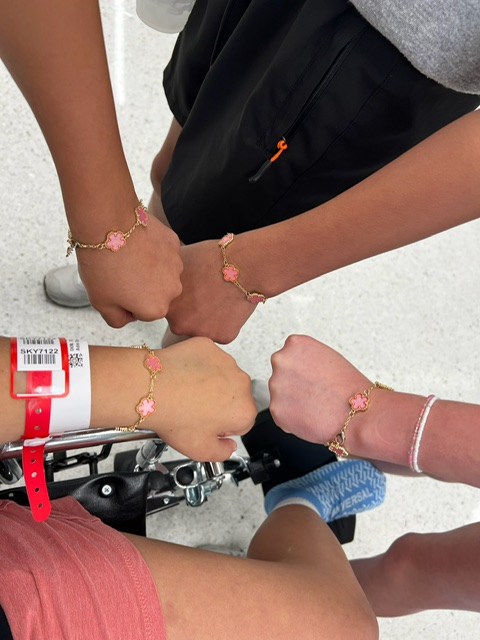
The next day, some of her friends came to visit. Emma, Avery, and Harper came by, and Kinley was so excited. She was still in pain, so we tried to time her morphine around the visit. The girls hung out and played games like Apples to Apples.
For a little while, the hospital room became something else.

It became a place where friends laughed.
It became a place where Kinley got to feel like a kid.
It became a place where cancer was still there, but it did not get to be the only thing in the room.
Cohen and I even found a basketball goal behind the hospital.
That sounds small, but small things were starting to mean a lot.
A blood transfusion.
A few hours of sleep.
A funny comment.
A friend visit.
A basketball goal.
A future trip.
A prayer from someone across the country.
A children’s book that suddenly carried more weight than ever before.
These were not small things anymore.
They were pieces of grace.
We still did not have all the answers. We were still waiting. We were still scared. But God was giving us enough to get through the day.
Not the whole road.
Just the day.
And maybe that is how He carries us sometimes.
Not by showing us every place we will go.
But by giving us enough grace for the next step.