
Saturday, May 18th, started like any other weekend—full of promise, laughter, and plans. Megan and I had a rare chance for a night out. We drove to Lake Charles for a date night: dinner, a comedy show, and a little bit of normal. Kinley had been under the weather, but she was in good spirits and excited to spend the night with her cousins and Lulu. Her pediatrician had her on medication, and we had follow-up appointments lined up for Monday. So, we went.
By the time we got home Saturday around lunch, the plan was to take it easy. Kinley was still tired and not herself, but we chalked it up to whatever bug she was shaking off. We even popped into a neighbor’s birthday party briefly—Kinley was friends with their daughter, but this time she didn’t want to go. She said she just wanted to rest.
That evening, we sat down for dinner together. Kinley was at the table with us but didn’t feel like eating. Later, around 9:00 p.m., we went to tuck her in for the night—and that’s when things shifted. She was wincing in pain, crying off and on. We tried to comfort her, assuming it was just a bellyache. Her doctor had warned us that if the pain got serious or she spiked a fever, we should head to the ER.
We sat there, Megan and I, weighing what to do. That’s when Kinley—braver than any child should ever have to be—said, “I’d rather go to the ER.”
Megan said, “Okay, let’s go.”
I said, “No, I’m taking her.”
We hopped in my truck and headed to the Lafayette Children’s Hospital, having no idea that life as we knew it was about to be rewritten.
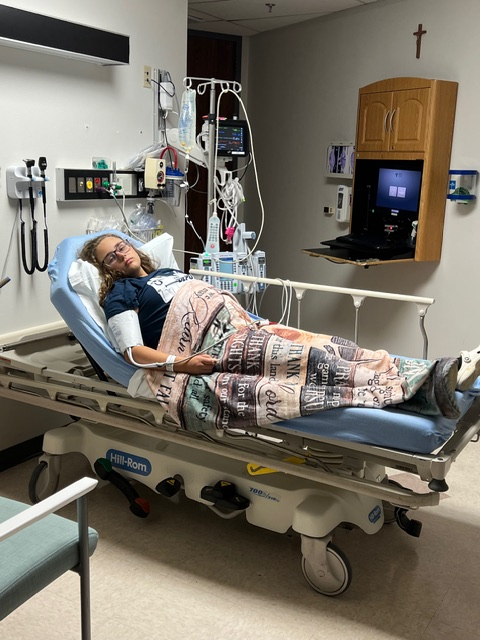
The ER waiting room was exactly what you’d expect—screaming babies, bubble guppies on the TV. Kinley was annoyed, but I reminded her this was all part of the deal. We got checked in and made it to a room by 10:45 p.m. Her stomach looked swollen. Nurses pressed around, asking where it hurt.

The ER doctor came in and ordered an ultrasound. He said something looked off, but there was too much fluid to see clearly. So, he ordered a CT scan.

Kinley was terrified. If you’ve ever had a CT scan, you know—it’s not friendly. Loud, dark, and cold. She had to lay completely still inside a spinning tube for fifteen minutes. She was so strong.
We returned to the room to wait.
At around 3:00 a.m., the doctor walked in and sat down in front of me. He looked like he didn’t want to say what he was about to say.
“We see something,” he said. “The way it looks on the scan… I’ve never seen anything like it in 30 years of practice.”
I asked, “Well, what is it?” I was thinking maybe a kidney stone or ulcer.
“It’s some sort of mass or tumor. It looks extremely rare and aggressive.”
My first thought wasn’t even about the diagnosis—it was frustration that he’d speak like that in front of a terrified 12-year-old girl who was already in pain.
He explained they were already on the phone with Children’s Hospital in Baton Rouge and St. Jude’s in Memphis.
“At 3 a.m.?” I asked.
“Absolutely,” he said.
That’s when it hit me. This wasn’t just a rough night. This was serious.
Megan and I had been texting throughout the night, but I hadn’t called her yet. I didn’t want to wake her if she was managing to sleep—she’d need her strength. Around 4:15 a.m., I finally texted her.
“It sounds like you’re going to need to plan to come here in the morning. They aren’t letting us go until they get more information.”
It was a white lie. I didn’t want to say the real words yet. Not over text.
She replied, “Ok, I’ll come relieve you in an hour.”
I told her to find a place for Cohen, our younger son, and be at the hospital by 8.
She asked, “What’s at 8?”
I said, “Nothing specific.”
By 5:20 a.m., she was on her way. At 5:45, she texted, “I’m pulling in.” I met her in the parking lot.
As soon as she saw my face, she stopped. “Oh no, it’s bad, isn’t it? Don’t do this, not today.”
I couldn’t hold it together anymore. I broke down. Right there in the lot.
“They found something. It’s rare. It’s not good.”
We stood there a while, talking through everything. When the Oncologist came in later that morning, I made it clear—no diagnosis talk in front of Kinley. He agreed.
Out in the hallway, he told us he’d been on the phone with other doctors in Baton Rouge and Memphis.
My stomach dropped again. It was early Sunday morning, and they were pulling in specialists across the country.
He said, “We believe the best thing to do is get Kinley to Baton Rouge today. Further testing, then we’ll decide on Memphis or next steps.”
Still clinging to some denial, I said, “She has an awards banquet tomorrow. She’s in gifted classes—it would mean so much to her. We can drive her down tomorrow afternoon.”
He paused, then said clearly, “We’re about to schedule an ambulance to take her as soon as possible. This is way more important.”
That was the moment reality finally hit me full force.
Megan would ride in the ambulance with Kinley. She ran home to pack a bag, but as soon as she got there, the ambulance arrived. I called: “Babe, they’re here waiting for you.”
She scrambled, throwing random things into a bag—forgetting her motion sickness meds, of course—and was back in 15 minutes. Kinley was strapped in and ready.
Then it was my turn to go home. I packed slowly. I was in a fog. Still thinking, we’ll only be gone a few days, right?
This was the beginning of a battle we never saw coming.
Through the chaos, fear, and tears, God was present. I didn’t always feel Him in the moment, but looking back—I can see His fingerprints. In Kinley’s courage. In Megan’s strength. In the timing of every single step.
We are walking a road we didn’t choose, but we’re not walking it alone. And this story isn’t over.